


Which Commercial Handyman Services Fit in a Holiday Closure Week?
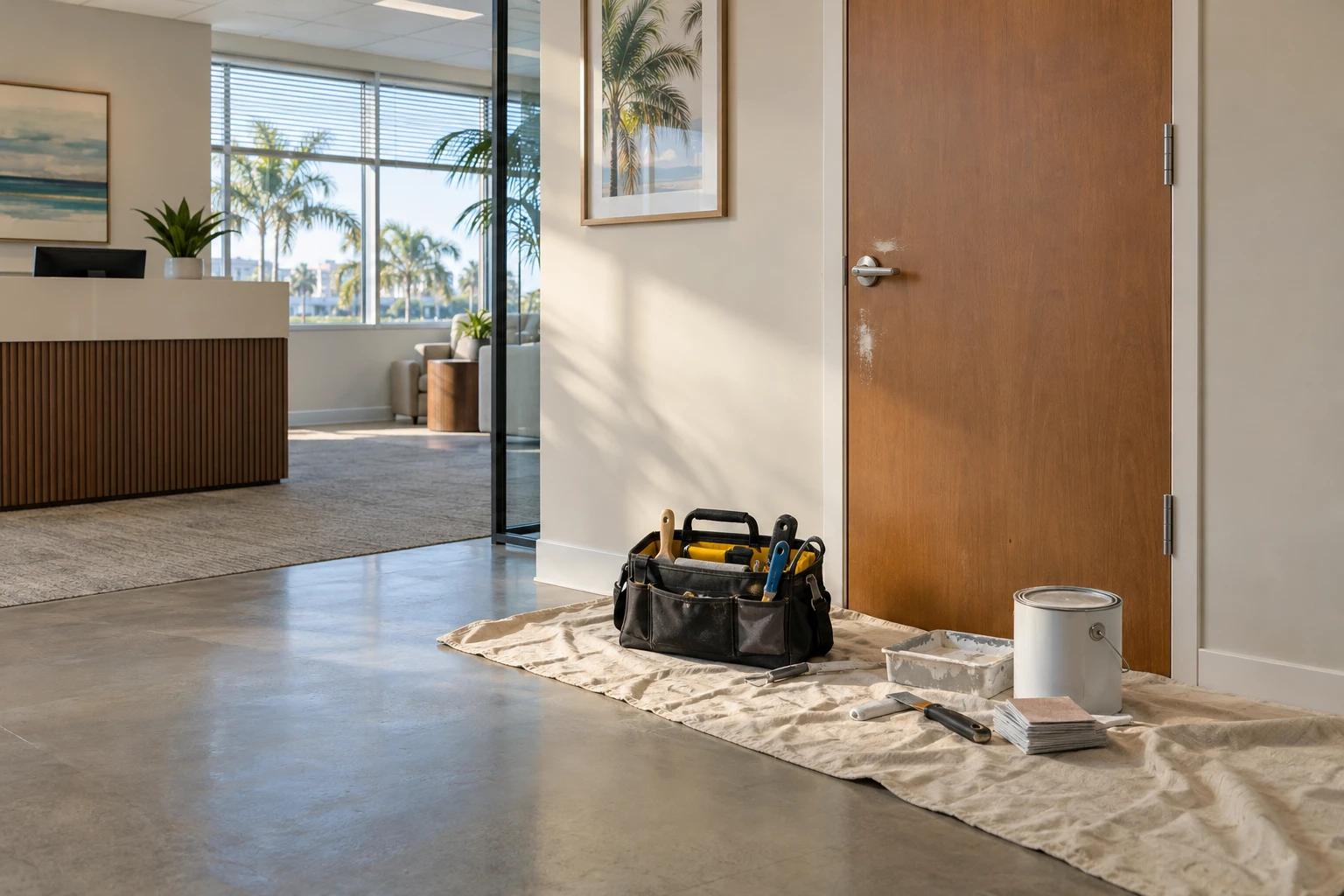
Most of the jobs that are hard to do with people around fit in a closure week. Drywall patches, paint touch-ups, doors that drag, stained ceiling tiles, and restroom fixtures are the usual list. Our commercial work covers the space your business already has, from one suite to several buildings.
Commercial handyman services are the same repairs and maintenance tasks we do in homes, done in buildings and facilities that have staff and customers. Here is what tends to fit, and why the quiet days help.
| The job | Why the quiet week helps |
|---|---|
| Drywall patches, dings, and cracks in halls, suites, and common areas | Patches get sanded and painted with no one walking past the dust. |
| Stained ceiling tiles and drywall ceiling patches | Ladders stand in open floor space instead of in someone's path. |
| Painting and touch-ups in lobbies, halls, and classrooms | No one brushes a sleeve against a wet wall. |
| Interior doors that stick or will not latch | A door can come off its hinges without blocking a busy hallway. |
| Flooring in a break room or a small suite | The furniture moves out of an empty room, not around working people. |
| Restroom fixtures, worn caulk, and grout | A restroom can close for a day without a line forming outside it. |
| Light fixtures swapped like for like | Nobody is working under the light while it is down. |
| TVs, whiteboards, and shelves mounted | Conference rooms and classrooms are empty, so every wall is easy to reach. |
Repairs that suit a closed or quiet holiday week
A bigger job, like a new wall that turns open space into an office or a restroom rebuild, is a remodel. That is permitted work under our contractor licenses, and it starts with a walk-through and a written scope. If one of those is on your list, call now rather than the week you close.
What Should We Line Up Now, Before the Building Closes?
A written list, the keys, and one person who can say yes. With those three things ready, a closure week goes to repairs instead of phone calls.
The timing works in your favor. November and December are the quietest months of our year, and we can usually schedule within a week. Here is the order most businesses follow.
- 1
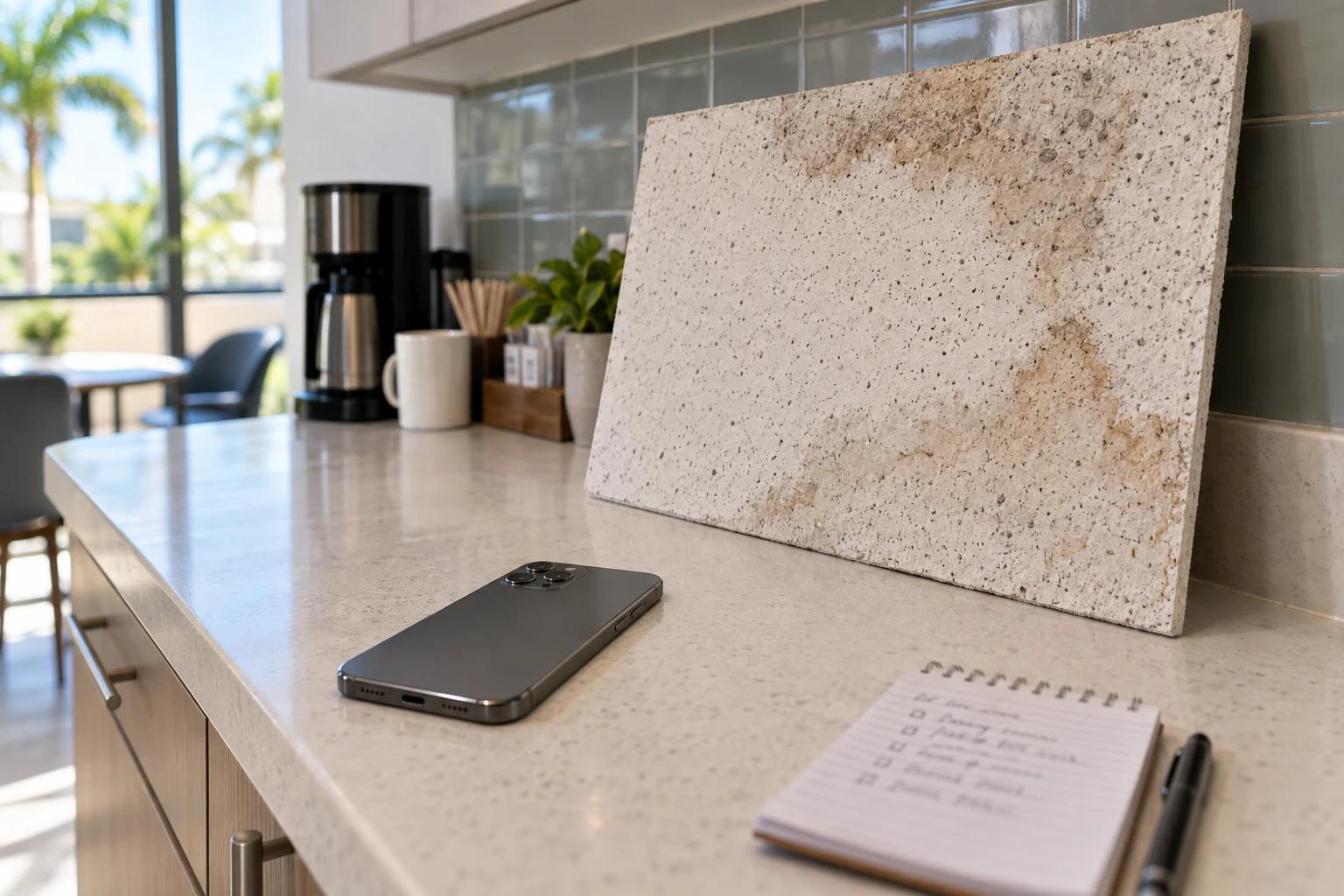
Walk the building with your phone
Go room by room and write down every problem, large or small. Take a photo of each one.
- 2
Send the list
Use the estimate form or call. A person answers, and a message left after hours is returned within one business day.
- 3
Walk-through and a written price per job
We look at the space, then put a written price on each job. You can approve some now and save the rest for later.
- 4
Paperwork to your file
The license numbers and a certificate of insurance go to you before work starts, so your records are complete.
- 5
Access and a contact
Tell us who holds the keys and the alarm code, and who to call with a question.
Lists are ordinary for us. Of 121 estimate requests pulled from our website between October 8 and November 19, 2026, 52 of the 117 that described the work listed two or more separate jobs. One handyman can take a long list in a visit, and it costs less than calling us out for each task.
How Does the Work Go If the Building Is Empty, or Still Open?
Either way works, and only the plan for moving through the space changes. In an empty building, the handyman works the list from start to finish with the contact you named. Photos of the finished work are yours for the asking.
If the doors stay open, the handyman works one area at a time. Work areas get taped off, drop cloths go down to protect the floors, and the floor is clean before he leaves. Your staff and customers stay safe, nobody steps over tools, and your operations keep going.
A Clearwater dental clinic had new flooring put in while it stayed in business: "Even during the project, they ensured minimal disruption to our operations. Once the job was completed, everything was thoroughly cleaned, leaving the space looking immaculate and ready for use." (Sabi V., Google review of the Clearwater office)
What Paperwork Should a Business Have Before Work Starts?
Enough documentation to put in the property file and show the owner or the board. We have all of it ready before a ladder comes through the door.
- Contractor licenses. The Handyman Company is a state certified residential and building contractor, CRC1336072 and CBC1258366. You can look both up at myfloridalicense.com.
- Insurance. We are licensed, insured, and bonded, and a certificate of insurance is available on request before work starts.
- A written price per job. The quote you approve is the bill you get. Anything found once a job is open gets its own written price for you to approve first.
- One point of contact for every location, from the first walk-through to the final walk.
- A one year warranty on the workmanship. If something we did is not right, we come back and make it right.
The handymen on the job work directly for us, under our licenses and insurance. You are not handed to a stranger from a lead site. There are no long-term contracts, and each job is approved on its own. Before you call, it helps to read what to ask a commercial handyman and the answers for businesses, landlords, and boards.
Can One Company Cover Every Location We Run?
Yes, wherever your buildings sit near one of our six offices: Tampa, Orlando, Jacksonville, Clearwater, Sarasota, and Melbourne. Each office covers the towns around it, and one number reaches all of them.
You get one point of contact for every location. Each building gets the same written price per job and the same one year warranty a homeowner gets. If you manage rental units too, services for property managers run the same way.
A Sarasota customer wrote about the office side of things: "They are quick to respond, send the best people to do any job I have at our office, and the job is done right and in good time." (ohmyh2, Google review of the Sarasota office)
Do Churches, Schools, and Restaurants Book the Same Way?
They do, and each kind of facility has its own quiet window.
- Churches. Church maintenance often fits the weekdays between services. Fellowship hall walls, classroom doors, restroom fixtures, and grab bars for older members are common requests.
- Schools. Winter break is a long stretch when classrooms sit empty. School maintenance lists tend to be hallway drywall dings, classroom doors, painting, and whiteboards or shelves that need to go up.
- Restaurants. The day or two a restaurant closes is the time for dining room wall patches, trim, restroom fixtures, and shelves in the back room.
- Stores. Scuffed walls, a fitting room door that drags, and shelving are the usual retail list.
What Goes to Another Trade Instead?
Anything that is a licensed specialty trade of its own. Roofing, the HVAC system, changes to the electrical systems such as new circuits and outlets, and plumbing that moves all go to the right contractor. So does structural repair, and so does kitchen equipment in a restaurant.
Water damage is the common case where both of us are needed. If a ceiling stain came from a roof leak or an air conditioner, that leak gets fixed by its trade first. Then we repair the damage it left, from the ceiling tiles to the drywall and paint.
We say so up front and still finish the rest of the list. We also do not manage properties, so the building's manager or owner stays in charge of the job.
How Do We Get on the Schedule Before the Holidays?
Call 800-931-1106 or send the estimate form, and attach the list with a few photos. A person answers, and if you leave a message we call back within one business day. We can usually schedule within a week.
Someone walks the building, then each job gets a written price before work starts. Our own handymen do the work, neighbors from six Florida offices since 1999. If you want to know what moves maintenance costs, here is how handyman pricing works in Florida.
Whatever is on the building's list, we would be glad to come take a look and take care of it before you reopen.