

Can I Clean a Ceiling Fan Myself?
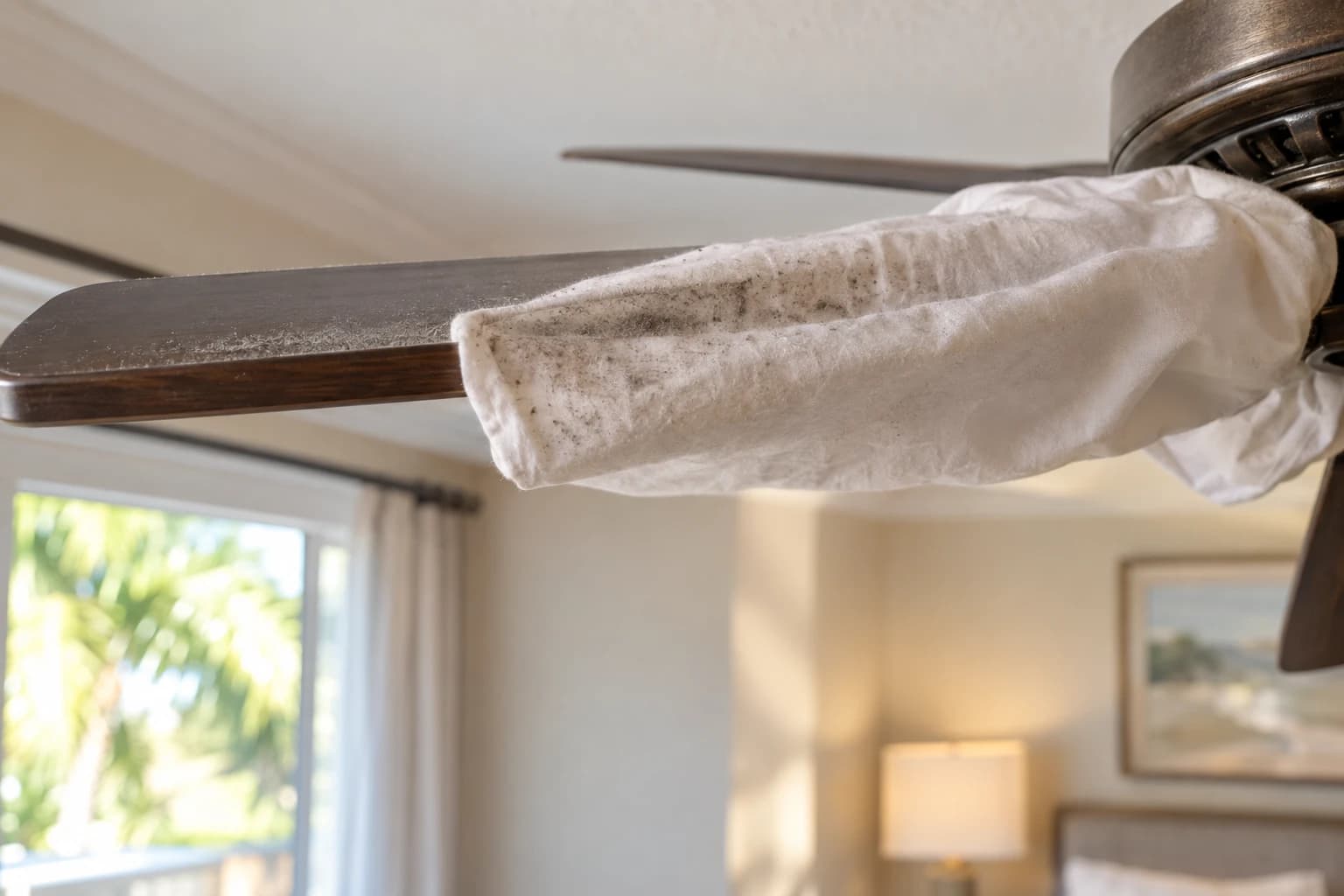
Turn the fan off and let the blades stop. Slide an old pillowcase over each blade, press it flat on the top, and pull it back so the dust stays inside the case. Wipe the blades with a damp cloth, then a dry one. Do not soak the blades, spray cleaner at the motor, or reach from a chair.
It is one of the easiest jobs in the house once you know the pillowcase trick. That felt of dust you never see from below goes airborne when the fan starts, which is why a room can feel dusty a day after you vacuumed. Cleaning the blades fixes that, and it takes a few minutes per fan. Here is how to clean ceiling fans the easy way, without the dust bunnies landing on the bed.
Everything you need is already at home, and none of it is a real tool. Gather it before you climb, because getting down for a rag is how a quick job turns into a chore.
- An old pillowcase, one you do not mind getting dirty. This is the whole secret.
- A step ladder that puts your shoulders level with the blades, or a sturdy step stool for a low ceiling, and a helper to hold it if the fan is over a bed or a tall ceiling.
- A damp microfiber cloth and a dry one. Plain water is enough; a drop of dish soap or a splash of white vinegar in the water cuts kitchen grease and dirt.
- A soft brush or the brush head of your vacuum for the motor housing.
- A towel or sheet for the floor, the bed, or the furniture underneath, because some dust always settles where you do not want it.
How Do I Clean Ceiling Fan Blades Without Dust Everywhere?
With a pillowcase. Every other method, a duster on a pole, a rag, a vacuum wand, pushes the dust off the edge of the blade and onto the bed. The pillowcase catches it. Here is the whole job in order.
- 1
Turn the fan off and let it stop
Switch it off at the wall and wait for the blades to come to a full stop. If the fan has a light, turn that off too, so you are not working under a hot bulb.
- 2
Cover what is underneath
Lay a towel or old sheet over the bed, the dresser, or the table. A little dust always slips past, and this is where it lands. If anyone at home has allergies, this step matters more than the rest.
- 3
Set the ladder and climb once
Put the step ladder where you can reach the blades at shoulder height without stretching. Have someone hold the ladder if the ceiling is tall. That is the whole safety rule: reaching from a chair is how people fall, and a fall costs more than a fan.
- 4
Slip the pillowcase over a blade
Slide the open end of the pillowcase over the blade all the way to the motor. Press the fabric down onto the top surface of the blade and pull the pillowcase slowly back toward you. The dust rolls off the blade and stays inside the case instead of drifting down.
- 5
Repeat for every blade, then shake it out outside
Move to the next blade and do all of them before you take the pillowcase off the ladder. Shake it out over the yard or a trash can, not in the room. Turn it inside out and toss it in the wash when you are done.
- 6
Wipe the blades with the damp cloth
Now that the loose dust is gone, wipe the top, bottom, and edge of each blade with the damp cloth and follow with the dry one. In a kitchen the dust is stuck in a film of cooking grease, so this pass is what actually gets the blade clean. Do not soak the blade. Wood and pressed board blades warp if they get wet.
- 7
Wipe the mounting bracket where each blade meets the motor
Dust piles up on the little metal arms that hold the blades. A quick wipe there keeps the fan looking clean from below, and it lets you see the screws, which matters in the next step.
If the fan is too high for a step ladder, the pillowcase still works on an extension pole made for it, or a long-handled duster with a bag. A vaulted ceiling fan that nobody can reach safely is a fair thing to add to a handyman visit; we bring the right ladder and it takes minutes.
What About the Motor Housing and the Light Globes?
Wipe the housing, wash the globes, and keep water away from the motor. The round housing above the blades gets the same felt of dust and a wipe with the damp cloth takes care of it. Use the soft brush on the vents where air goes into the motor, because dust packed into the vents makes the motor run hot and loud. Never spray cleaner at the housing. Mist it onto the cloth instead.
The light fixture cleans up the same way, and the globes come down for it. Most are held by a ring or by small thumbscrews; remove them one at a time and support the globe with one hand while you loosen them so it does not drop. Wash the globes in warm soapy water in the sink, dry them fully, and put them back. A clean globe throws noticeably more light, which is often the real reason a room felt dim. While the globes are off, this is a good time to swap a dead bulb, and if the fixture itself is tired, new lighting is a quick handyman job.
Why Does My Fan Wobble After I Clean It?
Usually because the cleaning moved a blade, and it is an easy fix. Blades sit on arms held by a few screws, and years of running loosen them. When you press on a blade to wipe it, a loose blade shifts a little, and the fan wobbles when it starts back up. Turn the fan on low and watch it for a minute. A slight shimmy is normal. A blade tip that dips or a fan that swings on its rod is not.
Turn it off and check every screw where the blades meet the arms and where the arms meet the motor. Snug them by hand with a screwdriver; do not crank on them. Then measure from the ceiling to the tip of each blade. They should all match. A blade that sits lower than the others is bent at the arm and can usually be eased back into line by hand. Run the fan again. If the wobble is still there, a fan balancing kit from the hardware store, a small clip and stick-on weights, finds the heavy blade in a few tries.
Which Direction Should a Ceiling Fan Turn in Summer?
Counterclockwise in summer, so you feel a breeze standing under it. That breeze does not cool the room; it cools you, the way a breeze does outside, so you can set the thermostat a couple of degrees warmer and feel the same. Flip the fan the other way in winter, on low, and it pushes the warm air that pools at the ceiling back down the walls. In a Florida house the winter setting matters for about a month, but the summer setting is worth checking every time you clean.
The switch is on the side of the motor housing, and cleaning day is the easiest time to reach it. Turn the fan off, let it stop, flip the switch, and turn it back on. Stand underneath: if you feel the air, it is set for summer. If you feel nothing but see the blades moving, it is set for winter.
When Is the Fan Itself the Problem?
When cleaning and tightening do not fix the noise or the wobble, or when the fan hangs from a box that was never meant for it. A clean, balanced fan should run quiet on every speed. A hum that changes with speed, a click every rotation, or a fan that still swings after balancing points to a worn motor, a bent rod, or a bad mount, and none of those are worth your weekend. Older fans also lose speed as the bearings wear, so a fan that never seems to move air anymore is telling you something.
That is where a handyman visit earns its keep. Our craftsmen hang new fans from a fan-rated box, balance them, and test every speed before they leave, and the fan and the light fixture in the next room go on the same written price. Send us a short video of the wobble or the noise, and we will tell you before anyone drives out whether it is a tighten, a balance, or a replacement. Flickering lights or a breaker that trips when the fan starts belong to an electrician, and we say so. Everything else on the fan is handyman work, and we would be glad to take it.