Why Do I Need a Stud Before I Hang Something Heavy?
Because drywall alone will not hold it. Drywall is a half inch of pressed gypsum wrapped in paper. It holds a picture frame on a nail all day. It drops a 60-pound TV on the floor the first time somebody bumps it.
Wall studs are the vertical wood or metal framing behind the drywall. They are what a screw needs to bite into when the thing you are hanging weighs more than a coat. Shelves, TV mounts, curtain rods over a wide window, bathroom grab bars, and anything a child might climb all belong in a stud, not in a drywall anchor.
A stud finder is a nice tool and a cheap one. It also lies on textured walls, on plaster, and on the block construction half of Florida is built from. Our craftsmen find studs on every job, and most days nobody reaches for one. Here is how they do it, in the order they do it.
How Far Apart Are Wall Studs?
Sixteen inches, center to center, in most wood-framed houses. The middle of one stud to the middle of the next is 16 inches. Some newer homes, most garages, and many interior walls that carry no weight use 24-inch centers instead.
Each stud is a 2x4 that really measures one and a half inches wide. Once you have found one stud, its neighbors sit 16 or 24 inches to either side, give or take an inch where the framer made a cut.
Framers start the layout from one end of the wall, so the rhythm is reliable in the middle of a wall. It breaks down near corners, doors, and windows, where extra framing goes in. Measuring from a corner works best three or four feet in from that corner.
How Do I Find a Stud Without a Stud Finder?
Use two of these together and you will land on a stud nearly every time. Knock first, confirm with a magnet, and only drive a nail when the wall is getting patched or painted anyway.
- 1
The knock test
Tap the wall lightly with a knuckle, moving sideways a couple of inches at a time. Over the open cavity between studs you get a hollow sound. Over a stud the sound tightens up, higher and shorter. Knock across two feet of wall and you will hear the rhythm change every 16 inches. The knock test is fastest on smooth painted drywall and hardest on heavy knockdown texture, so pair it with a magnet.
- 2
A magnet
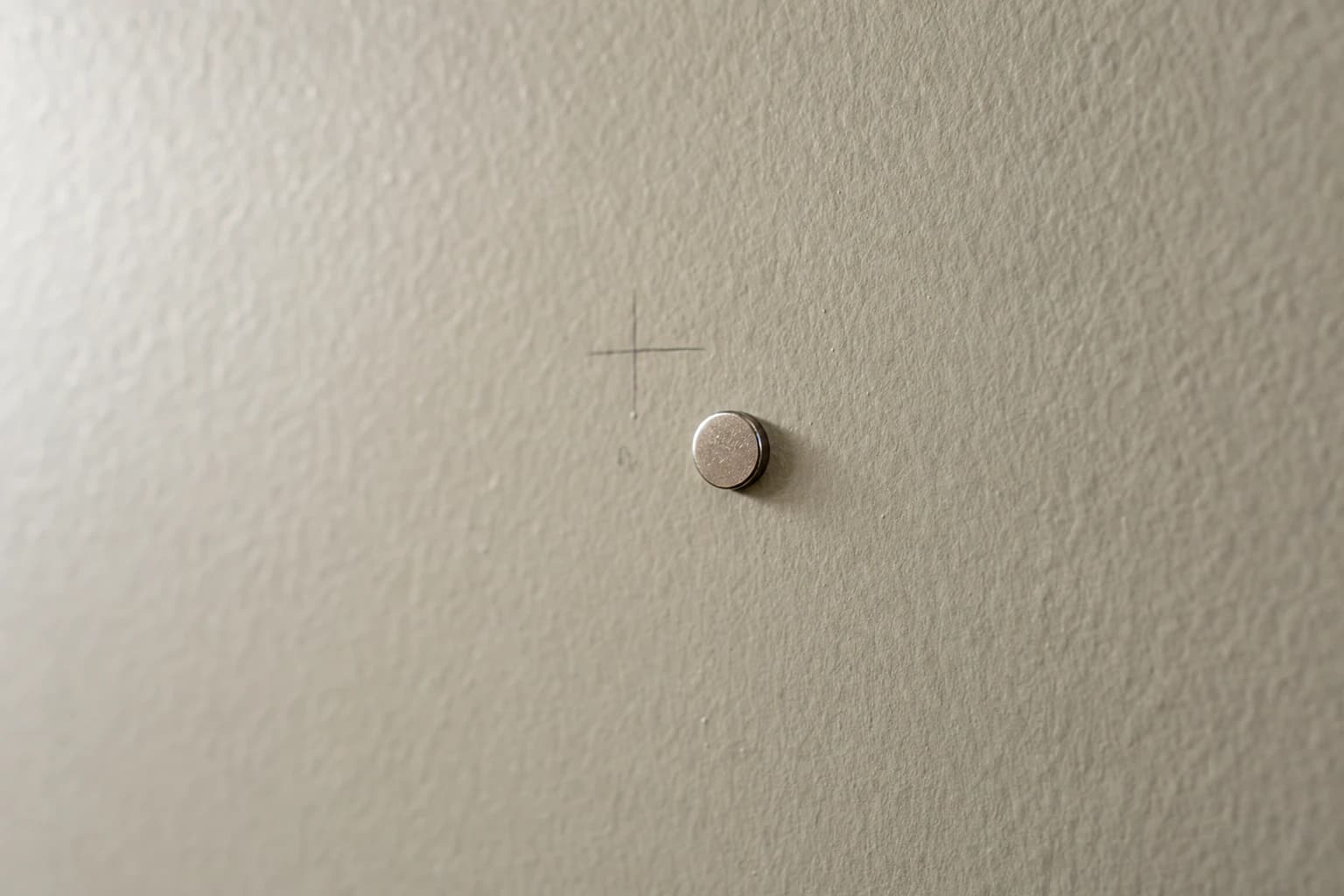
Drywall is fastened to studs with screws or nails every 12 to 16 inches up the stud. A strong magnet, the kind off a tool holder or a good refrigerator magnet, will stick when it passes over a screw head under the paint. Slide the magnet slowly in a zigzag across the wall. Where it grabs, you have found a fastener, and a fastener means a stud. Find two screws in a vertical line and you have the stud's center. On metal-stud walls, common in Florida condos and offices, the magnet sticks to the stud itself, which makes this the best method of all.
- 3
Measure from the corner
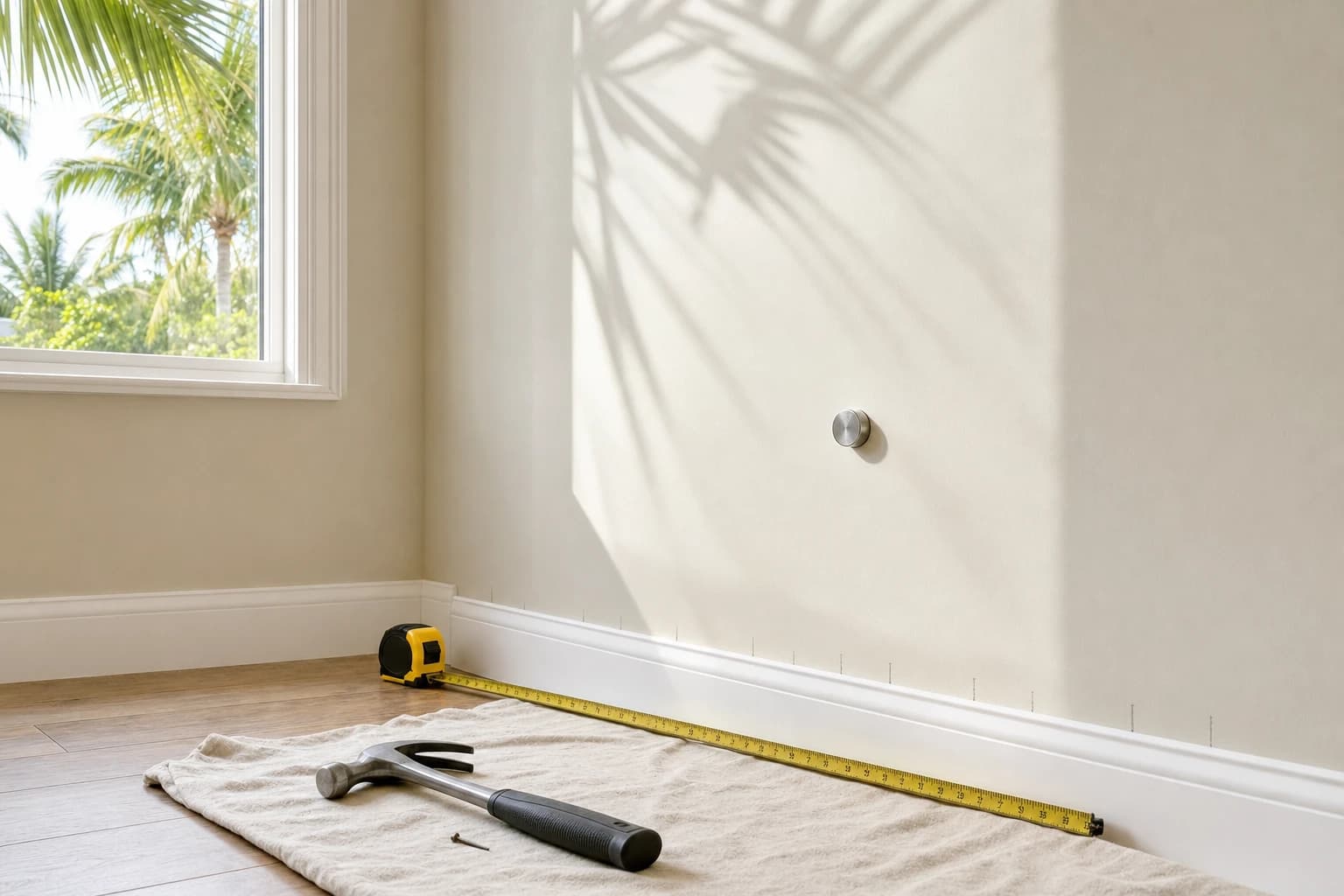
Hook a tape measure into a corner of the room and mark 16 inches, 32, 48, and so on with a pencil. One of those marks will be close to a stud center on most walls. It is rarely exact, because the first stud in a run is usually set so the drywall sheet breaks on center. Use the measurement to narrow the search, then the knock test or magnet to pin it down.
- 4
Look at light switches and outlets
Electrical boxes get nailed to the side of a stud. Take the cover off a switch plate or outlet plate and look at which side the box is fastened on. That side has a stud, and its center is about three quarters of an inch past the box edge. If you would rather not remove the plate, knock on both sides of the outlet and listen for the solid sound. From that stud, measure 16 inches in either direction to find the rest.
- 5
Check the baseboard and trim for nail dimples
Baseboard and crown molding are nailed into studs, and even under paint the nail heads leave tiny dimples. Hold a flashlight flat against the wall so the light rakes sideways across the trim. The dimples show up as small shadows in a line every 16 inches. Look up the wall from one of those dimples and you are looking at a stud. The same trick works on the drywall itself: raking light often shows the faint vertical row of screw heads under the paint, especially on a wall that has never been repainted.
- 6
Confirm with a finishing nail
When it matters, prove it. Tap a small finishing nail into the wall where you think the stud is, low near the baseboard where a tiny hole will never be seen. If it sinks and stops after half an inch, you hit wood. If it punches through into nothing, you are in the cavity: pull it, move an inch to one side, and try again. Two or three tiny holes down by the baseboard tell you exactly where one edge of the stud is. A stud is an inch and a half wide, so mark the center from there, and fill the nail holes with a dab of spackle when you are done.
| Method | Works best on | Struggles on |
|---|---|---|
| Knock test | Smooth painted drywall | Heavy knockdown texture, plaster |
| Magnet | Any wall with screws, and metal studs | Walls with very few fasteners |
| Measure from the corner | The middle of a long wall | Corners, doors, windows |
| Outlets and switches | Any wall with a box in it | Nothing, once you find the box |
| Trim nail dimples | Painted trim under raking light | Trim buried under many coats |
| Finishing nail | When you need to be certain | A wall you cannot mark |
Which method fits your wall
Whichever method finds the stud, mark both edges with pencil and put your screw in the center. A screw driven into the edge of a stud splits the wood and holds half as well.
Where Are the Studs Around Windows and Doors?
On both sides of the opening, and more of them than you would expect. Each side has a king stud that runs floor to top plate, and next to it a shorter jack stud that carries the header, the beam over the opening. That gives you a solid three inches of wood on each side of the window, starting right at the edge of the trim. Above the header and below the sill sit short cripple studs, usually on the same 16-inch layout as the rest of the wall.
Curtain rod brackets that sit just outside the window casing almost always land over the jack and king studs. Measure from the edge of the casing outward, and the wood starts within an inch.
Mounting a TV above a window is different. The header is solid across the whole opening, but the cripple studs above it are short. Knock and use the magnet to find them instead of assuming the 16-inch rhythm carries through.
Doors work the same way. The stud beside a door frame is a king and jack pair, which is why a coat hook screwed into the wall right beside the casing never comes loose.
Can I Use My Phone as a Stud Finder?
Sort of. Stud finder apps use the phone's magnetometer, the compass sensor, to detect metal. They can find drywall screws the same way a magnet does, and a good one will register a screw head under the paint.
They cannot see wood, and they are far less sensitive than a real magnet, so they miss more than they find on a wall with only a few fasteners. If you have a phone and no magnet, try the app while sliding slowly, and confirm what it finds with the knock test. If you have a refrigerator magnet, use the magnet.
What About Florida Block Walls, Furring Strips, and Metal Studs?
A lot of Florida is not built with wood studs, and that changes the answer. Single-story homes across Tampa, Orlando, and the coast are concrete block. On an exterior block wall there are no wall studs at all. The drywall hangs on furring strips, thin pressure-treated wood strips fastened flat against the block on 16-inch or 24-inch centers. A furring strip is only three quarters of an inch deep, so a long screw punches straight through it into the block and holds nothing.
The knock test still works, because the strips still change the sound. For anything heavy on a block wall, the strip is not the anchor. Our craftsmen drill through the drywall and the strip into the block and use concrete screw anchors rated for the load. That is the right way to hang a TV, a large mirror, or a grab bar on an exterior wall in a Florida block home, and it is the reason a stud finder gives such confusing readings there.
Interior walls in the same house are usually wood framed on the normal 16-inch layout. Condos, townhomes, and commercial spaces often use metal studs. Metal studs are hollow steel channels, so the knock test is muffled and the magnet is the tool: it sticks to the stud face along its whole length. Screws into metal studs need to be self-tapping and rated for the weight, or a toggle anchor that grabs behind the stud web.
What Should I Check Before I Drill?
Wires and pipes. Electrical cable runs straight up from outlets and switches to the ceiling, and sideways between them at the same height. Plumbing runs behind bathrooms and kitchens. Code requires a metal nail plate where a cable passes through a stud within an inch and a quarter of the face, but older houses and rushed jobs do not always have them.
Stay off the vertical line directly above and below an outlet or switch. Keep screws short: an inch and a half into wood is plenty for most brackets. If you feel the drill bit break through into something soft, or you hear water, stop.
Turn the circuit off at the breaker if you are drilling anywhere near an outlet. It takes thirty seconds and removes the one bad outcome from a simple job.
When Is It Worth a Call Instead?
When the wall has to hold something that can hurt someone if it falls. Finding a stud to hang a picture is a Saturday job. A TV over 55 inches on an articulating arm puts real pull on the wall and belongs in two studs, or in block with the right anchors. Floating shelves that will carry books, a grab bar somebody's weight will land on, a heavy mirror in a bathroom with plumbing behind it, and anything on a block exterior wall are jobs our handymen do every week.
If you have found the stud and you still are not sure the wall will hold it, that is exactly the moment to call, and we are glad to take it from there. TV mounting, shelving, and grab bars get a written price before the work starts, our own craftsmen do the hanging, and every job carries a one year warranty. Tore the drywall trying an anchor first? Drywall repair makes that disappear too.