
So Can a Handyman Do Electrical Work or Not?
Yes, for one kind of job, and it happens to be the one most homes need. Swapping a light fixture or a ceiling fan on an existing box, on the wires and switch already there, is the one electrical task generally treated as handyman work in Florida. Everything that adds or changes wiring is a job for a licensed electrician.
That covers more than it sounds like. The brass dome in the hallway, the dining room chandelier you bought months ago, the bedroom fan that clicks: each one comes down and a new one goes up at the same box.
Florida has no handyman license, and the state draws the line with its contractor rules. The full set of Florida handyman license rules is worth a read if you are hiring for anything bigger. Nothing here is legal advice. It is how we read the rules we work under every day.
Which Electrical Jobs Go to a Handyman, and Which to an Electrician?
If the new part goes where the old part was, a handyman can usually take it. If a wire has to be added, moved, or repaired inside the wall, it is a licensed electrician's job. Here is how common requests sort out.
| A handyman can | Call a licensed electrician |
|---|---|
| Swap a ceiling light for a new one on the same box | Add a light where there is no box and no wire |
| Replace an old ceiling fan with a new one | Run new wire to a new fan location |
| Put a fan where a light hangs now, on the same switch | Add a wall switch where there has never been one |
| Hang a chandelier on a box rated for its weight | Add a new circuit |
| Trade a worn switch for a dimmer at the same spot | Add new outlets or move old ones |
| Tighten and balance a fan that wobbles | Any work in the electrical panel |
| Swap a vanity light or a pendant at the same box | Repair old, brittle, or damaged wiring |
| Patch the drywall once the electrician is done | Track down a breaker that keeps tripping |
Who does which electrical job in a Florida home
Outlets sit on the electrician side. Florida's rules list them with new circuits and panels, so we leave outlet work to a licensed electrician.
Why Does Florida Treat Electrical Work Differently From Other Repairs?
Because electrical is a licensed trade of its own, and a low price does not change that. Florida Statute 489.103(9) lets someone without a contractor license take casual, minor repairs when the whole job comes in under $2,500. That rule covers painting, drywall repair, carpentry, flooring, and most small repairs around a house.
It does not open the licensed trades. Electrical, plumbing, and air conditioning are regulated on their own. A small electrical job still needs the right license, however little it costs. The fixture and fan swap is the exception people point to, because nothing new is wired.
A handyman who advertises as an electrician loses the exemption, so watch the words in the ad. And the homeowner usually pays for unlicensed electrical work. The county can make you redo it under permit, and your insurer can deny a claim for property damage tied to unpermitted work. Before you hire anyone for wiring, ask for a license number and look it up at myfloridalicense.com.
What Does a Like-for-Like Light Fixture Swap Involve?
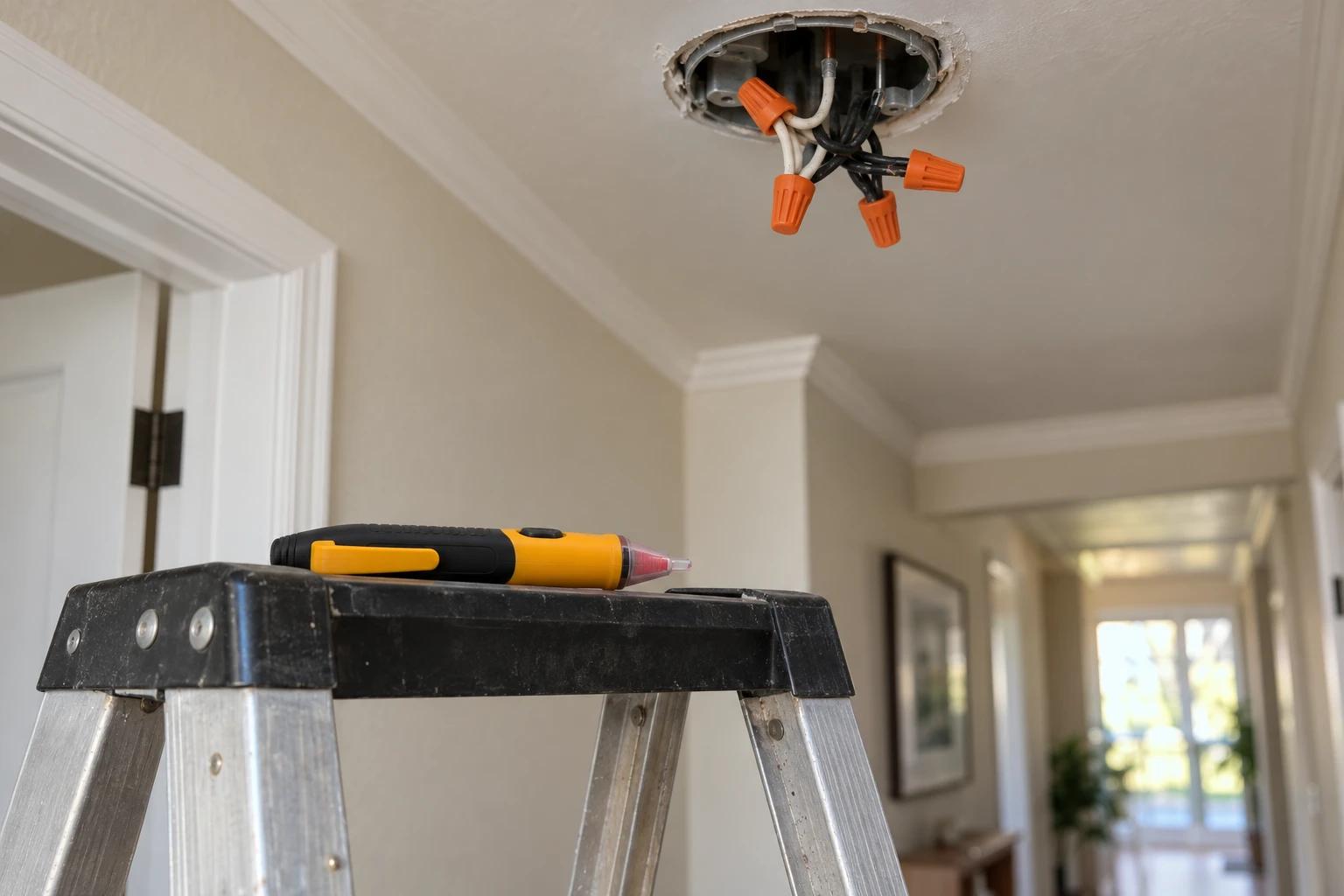
Less than you might fear, when the box is sound. A light fixture swap is mostly careful hands and a few simple tools: a ladder, a voltage tester, screwdrivers, and wire nuts. Here is the entire process, the way our handymen do it.
- 1
Power off, and proven off
The breaker goes off first. Then a voltage tester at the ceiling proves the wires are dead, because a wall switch alone is not proof.
- 2
The old fixture comes down
The canopy loosens, the wire nuts come off, and the old light is lowered to the floor, not dropped.
- 3
The box gets a hard look
We check that the box is fastened to the framing and rated for the new fixture's weight. A heavy chandelier needs a box built to hold it.
- 4
Wires connected right
Each splice is twisted tight under a wire nut, the ground wire lands on its screw, and every connection gets a tug. No electrical tape hides a loose splice.
- 5
Hang it, then prove it
The new fixture goes up level on its bracket, the light bulbs and shades go in, and we turn the power back on and work every switch.
The old fixture and the packaging leave with us. Already bought the new light fixtures? That is the most common version of this job. Our light fixture installation covers chandeliers, pendants, vanity lights, and porch lights too.
Is Hanging a Ceiling Fan Electrical Work a Handyman Can Take?
It is, as long as a box and a wall switch are already there. Replacing an old fan, or putting a new fan where a light hangs now, is one of the most common jobs on a handyman list in Florida.
The part that matters is the box you cannot see. Many ceiling boxes were put up to hold a light and nothing more. A spinning fan slowly works a light-only box loose. So before a fan goes up, we check the box, and if it is only rated for a light, a fan-rated box or a fan brace goes in through the same opening.
Out on a covered lanai, only a damp-rated fan belongs up there, because an indoor fan rusts in Florida air. One Orlando customer described a fan visit like this: "Rony installed our ceiling fan. He was prompt and professional. He also had to determine if we had an electrical problem." (Fay Darby, Google review of the Orlando office)
Checking before hanging is half the job. Once your new fan is running, here is which way a ceiling fan should turn in summer and winter. The full ceiling fan installation service covers vaulted ceilings, wobble fixes, and lanai fans too.
When Is a Simple Swap Not So Simple?
When the ceiling tells you something the store box did not. Most swaps go exactly as planned. These are the signs that a quick fix is really a wiring job, and a licensed electrician should take over:
- There is no box. A spot with no box and no wire needs new wiring run to it, and that is electrician work.
- The wiring behind the old fixture is old or damaged. Brittle insulation, scorched wire ends, or wires cut too short to reach are a stop sign.
- A breaker trips when the light or fan comes on. That can point to a short circuit somewhere in the wiring, and it needs a licensed electrician to trace it.
- Flickering lights in more than one room. A single light that flickers is often a worn switch, and we can swap that. Flicker across the house points past the fixture.
- A switch plate that feels warm, a buzzing you can hear, or a burning smell. Those are potential hazards, not repairs to put off.
- The box is too small or loose and cannot be fixed through the same opening. If the fix means opening the ceiling to rework wiring, the electrician comes first.
A light-only box under a new fan is the one surprise on this list that stays with us. We swap in a fan-rated box or brace and keep going.
What Happens If Our Handyman Finds a Wiring Problem?
We stop, show you what we found, and tell you plainly that it needs a licensed electrician. If your project crosses that line, nobody touches a wire that is not ours to touch. You call the electrician of your choice, and we can still complete the rest of the list that same visit.
Once the electrician has power where it needs to be, we would be glad to come back and hang the fixture or the fan. If the electrician had to open a wall or ceiling, we patch walls and ceilings as part of our everyday drywall repair work. A Tampa homeowner put it this way: "An electrician damaged our hardwood floors and Evan and the team at The Handyman company fixed our floors and it's like nothing ever happened." (Garet Marr, Google review of the Tampa office)
We would rather say no to one line on your list than do it wrong. Everything we do carries a one year warranty, and if something is not right, we come back and make it right.
Should I Swap a Light Fixture Myself?
You can, if you are comfortable on a ladder and you shut the power off at the breaker first. Many homeowners swap a simple flush light with the maker's instructions and a voltage tester. Follow the label, and test the wires before you touch them.
Where people get stuck is predictable. Old wires are too short. A chandelier is too heavy to hold overhead while you twist splices. A two-story foyer needs ladders most of us do not own. If that sounds like your ceiling, hand it off. Here is a fair look at when to hire a handyman and when to do it yourself.
Can a Fan or Fixture Swap Ride Along With My Other Repairs?
It can, and that is how most people book it. Of 80 estimate requests pulled from our website between October 8 and November 5, 2026, 36 of the 77 that described the work listed two or more separate jobs.
Light and fan installation and repair fit beside the other popular services on a list: curtain rods, shelf installation, a door that sticks, a drywall patch, a few baseboards. A Tampa customer getting ready to sell had one handyman cover a lot of ground: "He changed out 2 chandeliers, removed and re-caulked the wet areas, grouted my master shower, changed out a dimmer and replaced two bathroom faucets and a kitchen sink faucet." (Audrey Shurns, Google review of the Tampa office)
Bundling saves money because much of the cost of one small job is getting a handyman to your door. Cost will vary depending on ceiling height, how heavy the fixture is, and whether the box needs a fan brace. Here is how handyman pricing works in Florida, with the factors that move it.
Property managers and owners of commercial properties book the same kind of list, fixtures and fans across several units with one written price. Our handyman services cover home repairs and maintenance, carpentry, doors, and flooring, with remodeling under our contractor licenses.
Does a Licensed Handyman Company Also Cover Electrical Work?
Not the licensed electrical kind, and it is worth knowing why. The Handyman Company is a state certified residential and building contractor, licenses CRC1336072 and CBC1258366. As a licensed contractor, we can quote remodels and permitted construction work that an unlicensed handyman must turn down.
Those licenses do not make us electricians. Florida's rules say a licensed electrician holds that license, not a building contractor. So we do the fixture and fan swaps any handyman may take, and we point you to a licensed professional for the rest.
Here is how Florida decides between a handyman job and a contractor job, and our common questions about visits and warranties.
How Do I Get My Lights and Fans on the Schedule?
Call 800-931-1106 or send the estimate form, and tell us what is going up and where. Photos of the old fixtures help us bring the right hardware the first time. A person answers, and if you leave a message we call back within one business day.
Someone looks at the job and puts the price in writing before any work starts. You get peace of mind knowing the quote you approve is the bill you get. Our own handymen do the work, neighbors from six Florida offices, not a stranger from a lead site. Whatever is on your list, we would be glad to come take a look.